Join/Renew





AI is increasingly becoming an expectation for early career talent, shaping both the job market and entry-level work. Three results from the Job Outlook Spring Update survey underscore this:
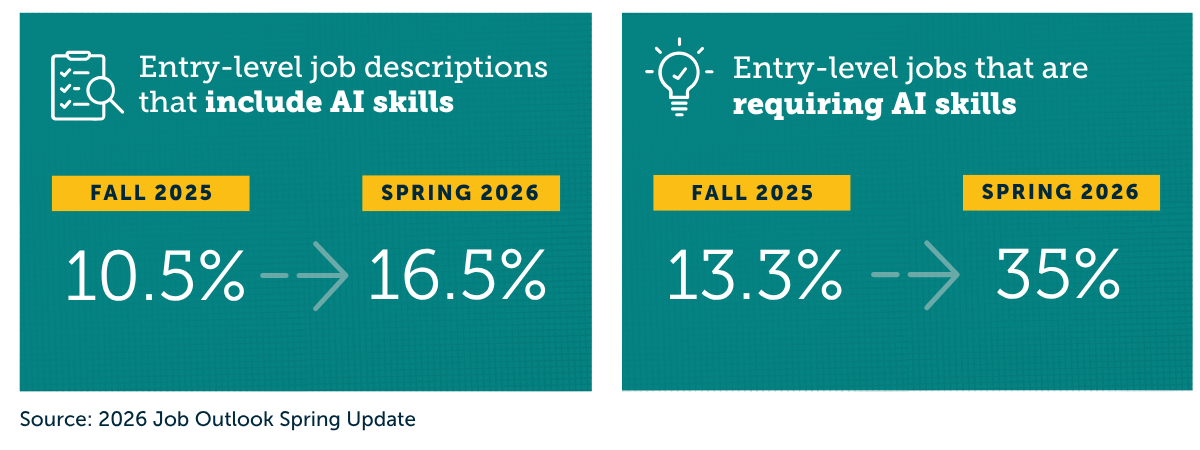
- Currently, more than one-third of entry-level jobs require AI skills, according to employers taking part in the survey. That’s nearly triple the amount that said this in fall 2025.
- AI skills are more prevalent in job descriptions now than they were just six months ago.
- And, 28% of employers say they are seeking early career talent who can use AI in their work, while nearly 60% say they are assigning interns projects that use AI tools and skills.
AI Effects on Entry-level Hires and Their Work
The survey also looked at how AI might affect entry-level work and the skills needed.
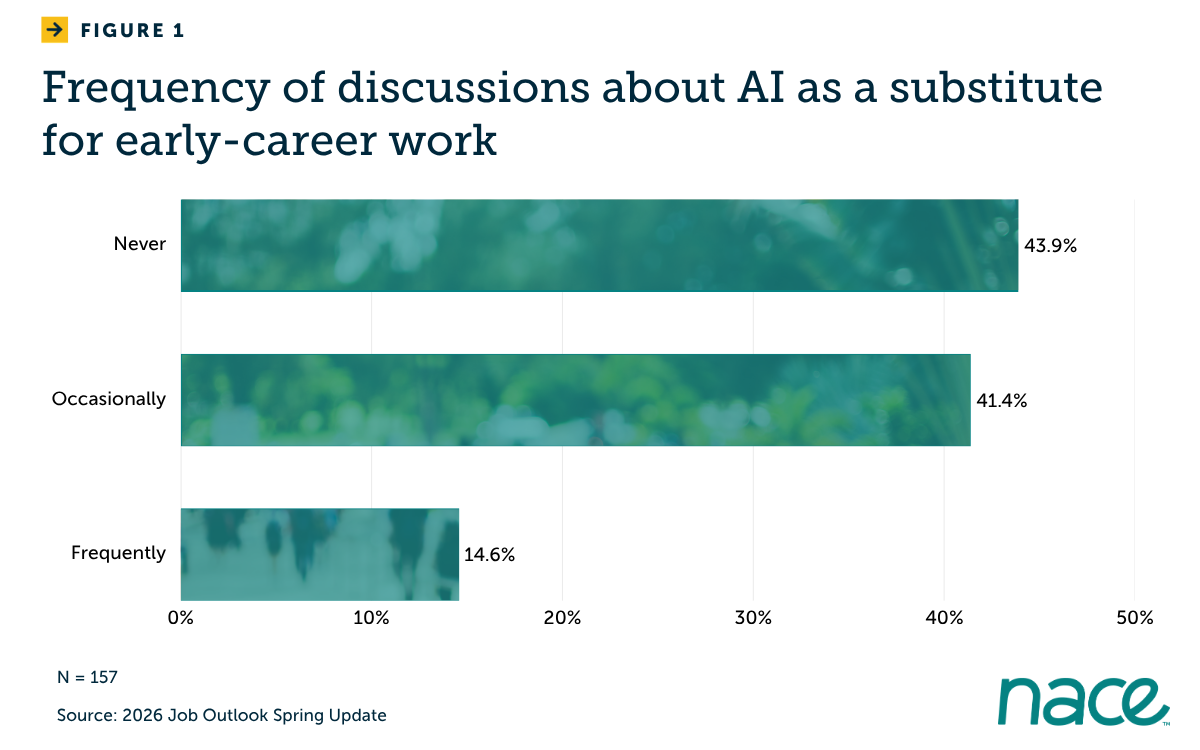
No surprise: AI’s effect on the nature of entry-level work is being discussed. (See Figure 1.) There are two aspects to these discussions, and it is important to consider both and what they mean for the early career workforce.
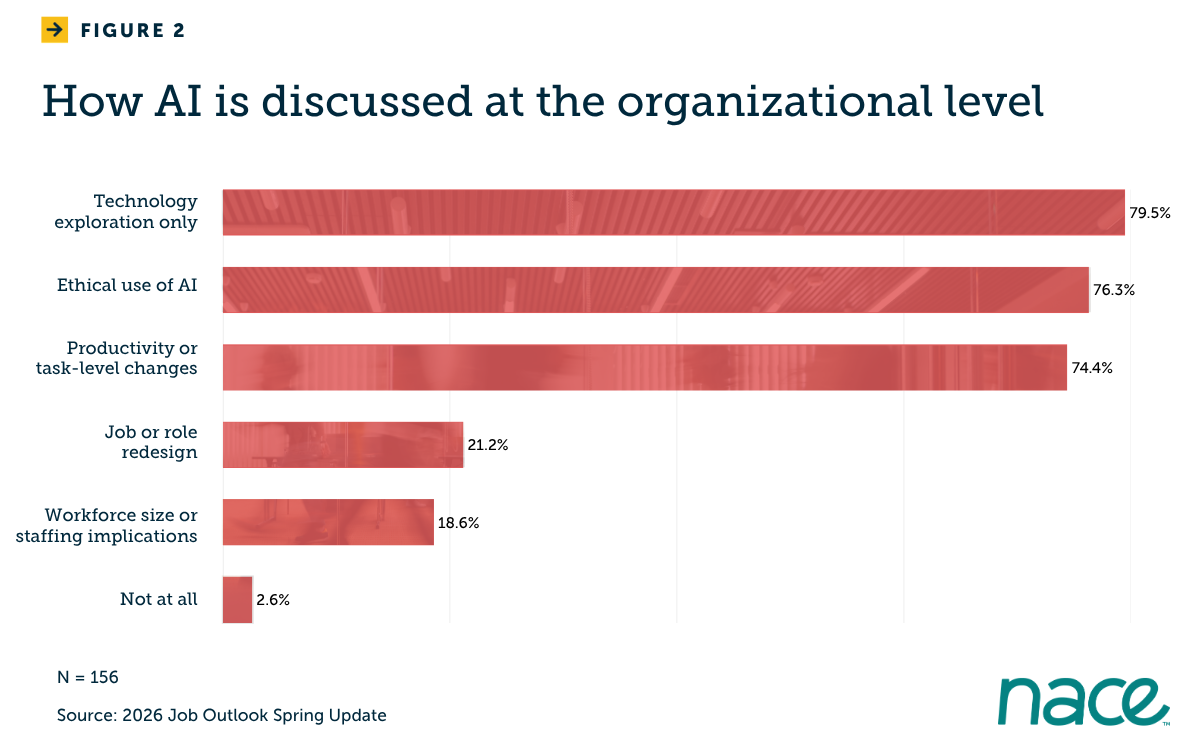
First, overall, the majority of employers having discussions at the organizational level are exploring the technology, considering ethical issues, and talking about productivity and task-level changes. At this juncture, AI’s impact on job design and staffing are under discussion by about 20%. (See Figure 2.)
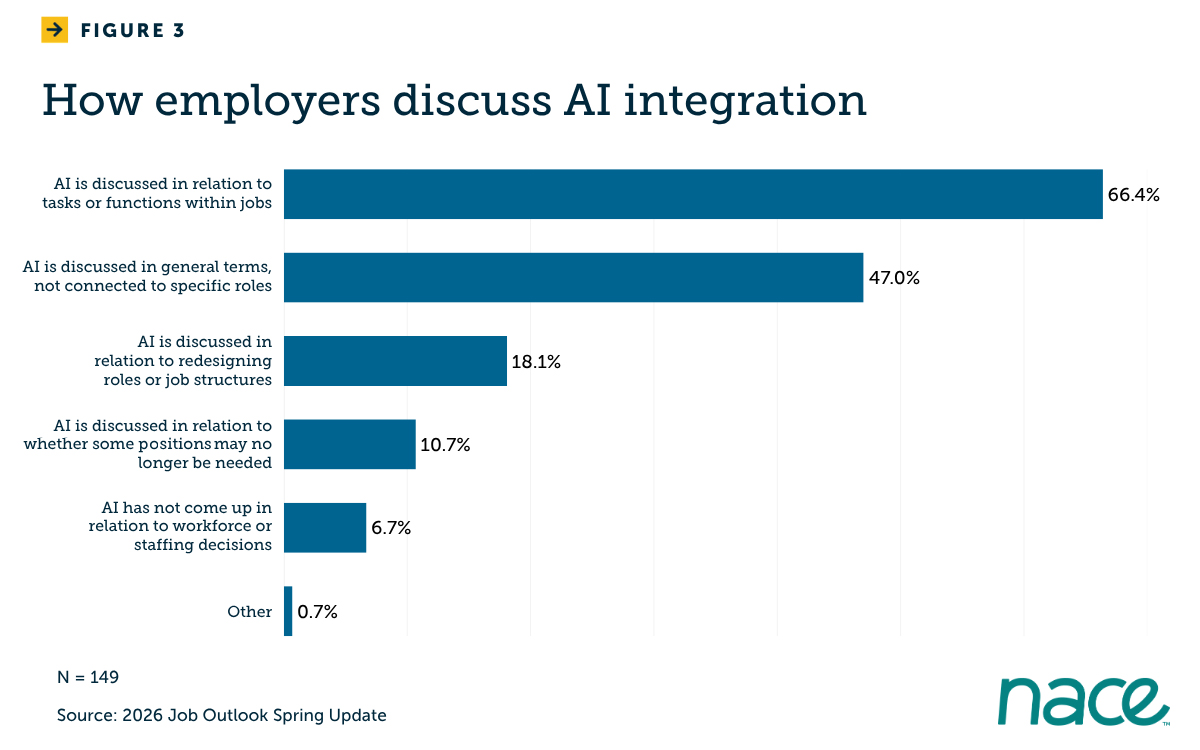
Second, in terms of workforce planning, more than two-thirds are considering how AI may be used in relation to tasks within jobs; just 11% are discussing how AI might replace some positions. (See Figure 3.)
Along those same lines, more than half of employers report that AI is not reducing the tasks entry-level workers perform, while just over one-quarter say AI has reduced the need for these tasks.
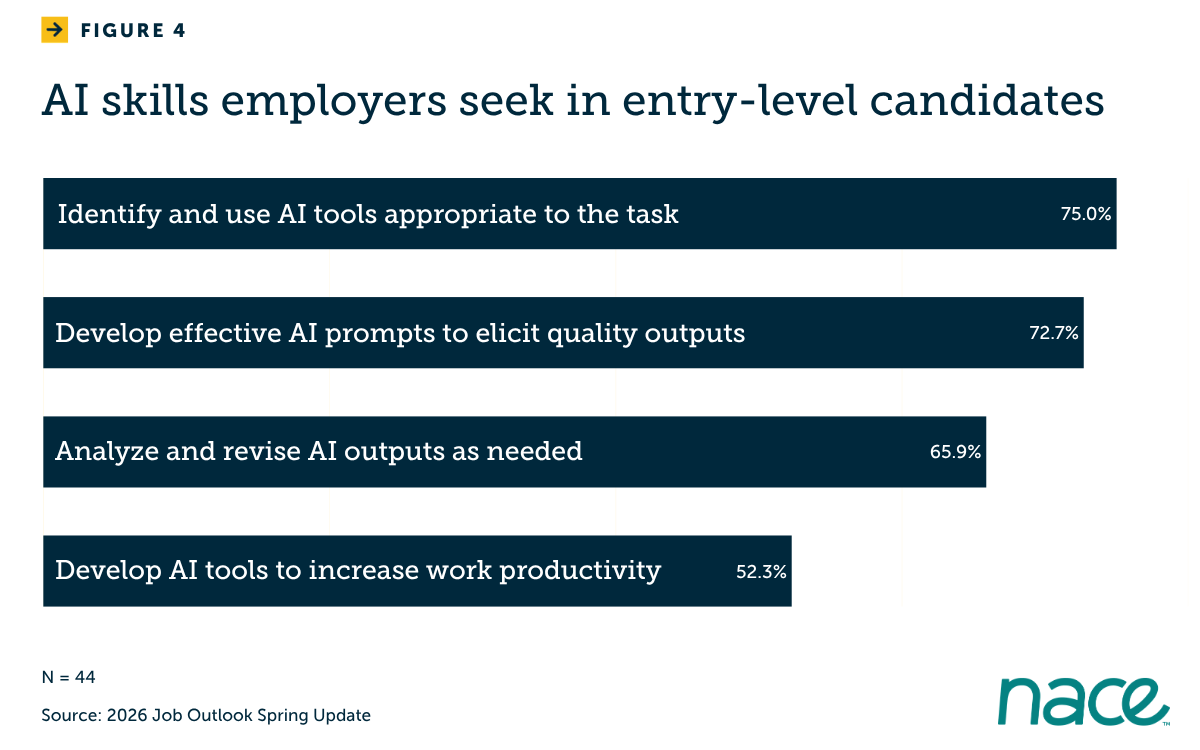
In addition, among employers currently seeking candidates who can use AI, the skills sought enable workers to use AI to complement, not replace, human work. (See Figure 4.)
These data point to AI largely reshaping—not replacing—early career talent and the skills needed to succeed.
Implications
Early career talent is increasingly expected to bring AI skills to the workplace.
To meet this expectation, higher education needs to incorporate AI into the curriculum—for all disciplines and levels—and consult with employers regularly to keep abreast of the tools and skills desired as well as evolving ethical and legal
issues.
Early talent recruiters can work with career services to communicate their organization’s specific needs related to AI and identify skills gaps. Recruiters can also loop their counterparts in on how AI is being incorporated into internships and
other programs—a value-add for organizations competing for top intern talent.
Career services can help students by providing guidance on the AI skills employers are seeking, connecting those skills to their career readiness, and thinking through how they can demonstrate to employers that they have the critical thinking and technical
skills needed to use AI effectively.
The Job Outlook 2026 Spring Update survey, sponsored by Jobscan, was conducted February 12 – March 17, 2026. Of the 185 total respondents, 142 were NACE employer members, representing 19.9% of eligible member respondents, and 43 responses were provided by nonmember companies. The survey updates hiring projections for the Class of 2026, which were reported in November 2025. (Note: Data are calculated on the number of respondents to a specific question. Total may not equal 100% due to rounding.)
See the full story
The results are in! Grab your copy of Job Outlook 2026: Spring Update to see what awaits the Class of 2026 as graduates enter the job market.
Get the report