Join/Renew





More than two out of five new college graduates (44%) had at least one job offer before graduation, according to results of NACE’s 2026 Student Survey.
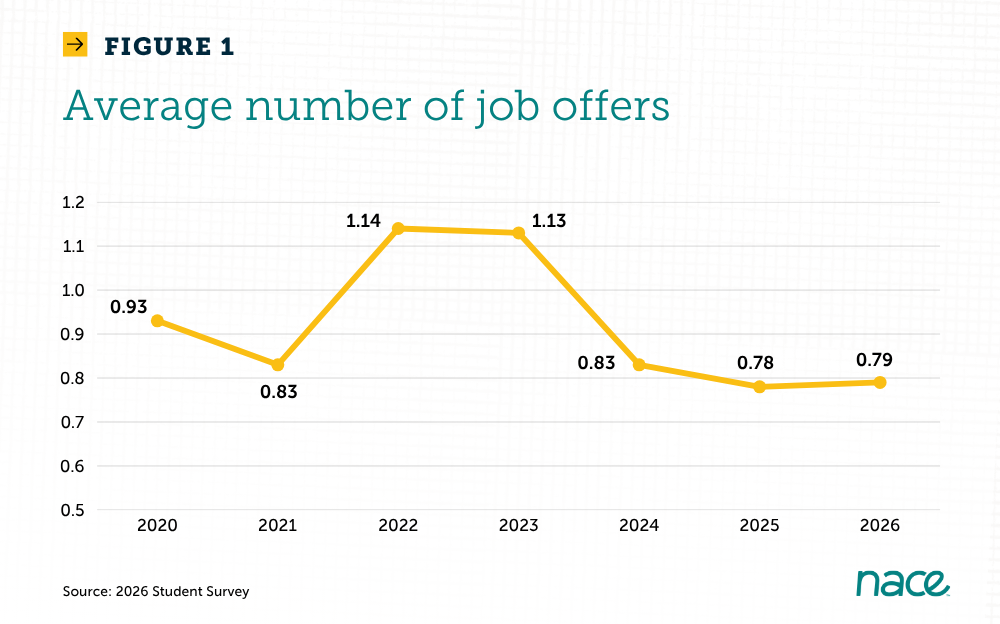
The survey found that, overall, 2026 bachelor’s degree graduates averaged 0.79 job offers before graduating.
That’s in line with what the Class of 2025 experienced, but well off the pace set by the post-pandemic bounce enjoyed by graduates in 2022 and 2023. (See Figure 1.)
What occurred with last year’s class may be happening again this year. Last year, many employers delayed making job offers until later in the spring. Because students complete the Student Survey before they graduate, it may be that some offers didn’t get recorded. That could be the case again this year.
Overall, soon-to-be graduates remain relatively optimistic about their job prospects following graduation, with 56% saying so.
The study also found that students who took part in a paid internship fared better: 55% of those who applied for a job received at least one job offer. In addition, paid interns with job offers were offered a higher average starting salary—$69,521 compared to $61,747 overall.
Taking part in a paid internship provides the student with a distinct advantage regardless of the job market. While students can’t control the job market, there are things they can do to better position themselves for it.
First, NACE research consistently shows that students who have served a paid internship fare better than other students. One of the reasons is that paid interns can be given real work—so they gain valuable experience that is attractive to employers.
Another critical piece for students is understanding how to translate their classroom work, extracurricular activities, part-time jobs, and other experiences into language that will appeal to employers. More and more employers are focusing on skills—not GPA—when they are hiring, so being able to provide examples of skills developed through their college experience is important.
Finally, students should learn how to use AI properly and ethically. Employers indicate they want new hires who can use AI to complement their work, and that means understanding how to create effective and accurate prompts, how to check AI’s outputs, and when it is and isn’t appropriate to use AI. A recent benchmark quick poll among NACE career services members found that more than three-quarters are discussing ethical considerations with their students and more than 80% are talking with them about the AI skills they may need in an AI-influenced workplace.
NACE’s 2026 Student Survey was conducted March 12 – May 15, 2026. More than 17,000 students from 258 colleges and universities nationwide took part, including more than 1,860 graduating seniors; results presented here reflect graduating senior responses.