Join/Renew


-

How We Lead: Theories of Career Services Leadership
Based on interviews with two dozen career services leaders, authors Dylan Houle and Jon Schlesinger explore career services leadership theories: servant leadership, authentic leadership, and situational leadership.
-

Recommended Reading
This list, provided by Dylan Houle and Jon Schlesinger as a companion to “How We Lead: Theories of Career Services Leadership,” is based on suggestions provided by career services leaders who took part in Houle’s podcast for the books, blogs, and resources that were meaningful to them in their leadership development.
-

Equity, Access Keys to Forging Partnerships Across Campus for New UT Austin Career Center
The University of Texas at Austin (UT Austin) is a public Research 1 university with 52,000 students and 18 colleges and schools, including medical and law schools. Like many large universities, UT Austin has a highly distributed model of 15 career centers within schools, and each area operates independently.
-

Alignment Shift Gives LaGuardia Career Services Access to More Resources, Industry Partnerships
During the pandemic in 2020, LaGuardia Community College—a public community college that is part of the City University of New York (CUNY) system—inaugurated a new president, who is an advocate for workforce development as well as for internships. In addition, the chancellor for CUNY established career services as one of his priorities.
-

Grant From UNCF the Catalyst for Elevation of Career Services at Tougaloo
A grant from the United Negro College Fund (UNCF) helped to move career services to a position of more prominence at Tougaloo College and embed career readiness in the school’s curriculum.
-

New Division at Michigan State Adds Research Component to Career Services
Career services at Michigan State University (MSU) is a centralized/hybrid organization of offices and is well-known for its Career Services Network, which is composed of career services professionals strategically located in central and college-based offices.
-
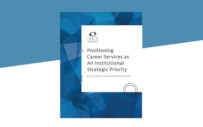
Positioning Career Services as an Institutional Strategic Priority
Career services needs to be strategically positioned on campus to provide the vision, guidance, and relationships to demonstrate its importance and value and to maximize student outcomes.
-

Reporting Directly to President a “Best-Case Scenario” for Grinnell’s Dean of CLS
Soon after Mark Peltz was hired as the associate dean and director of career development at Grinnell College, it began a process of institutional elevation and prioritization of career services.