Join/Renew





A new study investigates what student employability looks like in the age of artificial intelligence. Its findings point to implications for higher education, employers, and policymakers.
The rapid evolution of artificial intelligence (AI) is reshaping the landscape of higher education, not only in how the institutions teach and assess learning, but also in how they prepare students for an increasingly uncertain and dynamic employment landscape.1,2
AI has transformed the workforce by automating repetitive tasks, eliminating some roles entirely, and generating entirely new types of jobs.3,4 At the same time, employers are reevaluating employability, which entails the ability to obtain and maintain a job.5,6 Entry-level positions, which traditionally have served as training grounds for professional careers, are increasingly vulnerable to automation and restructuring.7,8 This is particularly concerning for new graduates entering a labor market characterized by rapid change, ambiguity, and evolving expectations.
These shifts have intensified broader questions regarding the role and value of higher education outcomes, particularly at a time when higher education institutions are already struggling with graduate underemployment and declining public trust, driven in part by concerns over poor student outcomes.9,10,11 Preparing students for jobs that do not yet exist adds another layer of complexity.
Existing models of employability have traditionally emphasized human capital, technical competencies, and credential attainment as primary indicators of career readiness.12,13 However, emerging evidence suggests that employers increasingly emphasize soft skills.14,15 Existing employability models do not fully account for an uncertain and rapidly changing labor market. Furthermore, employability, AI fluency, and workforce readiness are often studied in isolation.
My study addresses this critical gap by triangulating insights from higher education, employers, and workforce development experts to conceptualize a new model of student employability in the age of AI. While much has been written about the potential of AI to disrupt the workforce, there is limited empirical research exploring student employability from multiple perspectives.16,17 Using a constructivist grounded theory approach, this study investigates how employability is being redefined amid technological uncertainty and shifting labor market demands.18
Findings resulted in the construction of the agility, foundations, and differentiation (AFD) model, which positions employability as a dynamic and adaptive construct. The findings of this study suggest that student employability is a shared responsibility with implications for higher education institutions, employers, and policymakers.
Theoretical Framework and Methodology for the Study
To guide my qualitative study, I used Charmaz’s constructivist grounded theory (CGT).19 CGT helped with the emergence of a model grounded in data rather than seeking to validate existing models.
CGT emphasizes the co-construction of meaning between the researcher and participants, allowing insights to emerge organically through participants’ lived experiences. CGT was particularly well-suited for answering how-oriented research questions, such as how student employability looks in the age of AI. Its iterative nature allowed for continuous refinement of focus throughout data collection and analysis, enabling me to revisit themes, adapt interview protocols, and engage in theoretical sampling until saturation is achieved.
Most importantly, CGT emphasizes the importance of collecting as much data as needed to ensure rich, robust findings rather than relying on a predetermined number of participants and provided the flexibility to remain responsive to the data and change approaches. My initial interviews with three career services leaders in higher education informed my approach to expand the interviews to include perspectives from employer and workforce development experts to capture holistic insights. I continued the interviews (n=9) until theoretical saturation was reached.
Participants included career services and technology leaders from higher education, employers, and leaders with expertise in recruitment and workforce development. (See Table 1.) Sampling was purposive and criterion-based to ensure participants met key qualifications: at least five years of experience in higher education and their related area to ensure expertise.
Table 1: Participants
| Assigned Name* | Affiliation | Expertise | Role |
|---|---|---|---|
| Bob | Higher education | Technology, higher education | Leader |
| Sarah | Workforce development/ employer | Technology, employers, higher education | Leader |
| Bryan | Higher education | Workforce trends | Scholar/researcher |
| Jack | Higher education | Career services | Leader |
| Jerry | Workforce development | Higher education, workforce trends | Author |
| Sean | Workforce development | Higher education, employers, workforce | Leader |
| Prat | Higher education | Career services | Leader |
| Megan | Employer | Recruitment | Recruitment leader |
| Greg | Higher education | Career services | Leader |
* Names are anonymized.
The study used intensive interviewing, a method widely used in grounded theory research. Interviews ranged from one to two hours, depending on the participant’s responses. An intensive interview approach allowed for deep exploration of participants’ experiences, enabling flexibility to ask probing and clarifying questions throughout the conversation.
Following Charmaz’s CGT approach, data analysis of the transcripts included an iterative process of initial coding, focused coding, and constant comparison across interviews.
The diversity of the participants’ roles and backgrounds in relation to higher education and AI proved beneficial to the study as it helped inform a holistic view of student employability from the lens of career services/higher education, employers, and workforce development experts.
Developing the Agility, Foundations, and Differentiation Model
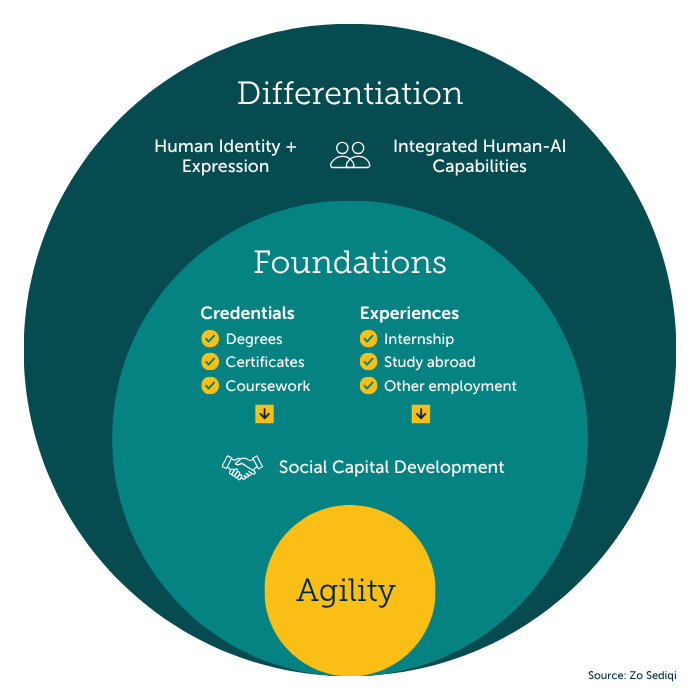
Through data analysis, I identified patterns that I compared and refined to develop higher-level conceptual categories. Through this analysis, I constructed the agility, foundations, and differentiation (AFD) model, which describes student employability in the age of AI, taking uncertainties into account. This model accounts for a fundamental shift, moving away from a primary emphasis on technical competencies toward a more integrated model, positioning agility, human identity and expression, and integrated human-AI capabilities as critical in employability.
As Figure 1 illustrates, the AFD model has three dimensions: 1) agility—the core, 2) foundations, which includes credentials and experiences, and 3) differentiation, encompassing human identity and expression and integrated human-AI capabilities.
Dimension 1: Agility
Agility is a central organizing element influencing employability in the age of AI. In this study, agility is a set of qualities that one possesses or develops, including the ability to continuously learn, adapt, navigate ambiguity, and have emotional intelligence to navigate the constant change.
Participants emphasized that navigating ambiguity, continuously learning, learning quickly, and responding to rapid shifts require one to be agile. Participants framed employability as grounded in a “lifelong learning paradigm,” in which one must continuously build new skills beyond one's initial degree.
Participants highlighted the importance of preparing students to evolve alongside shifting demands. As one participant noted, the goal is to ensure students can “adapt to these things and change” (Sarah). This reflects a broader recognition that careers are no longer linear but instead involve ongoing transitions, requiring individuals to reposition themselves repeatedly over time.
Agility was also closely tied to the ability to navigate ambiguity and uncertainty. Jerry emphasized that future employability depends on students’ capacity to “handle ambiguity, how to upskill themselves even as AI changes, and how to make sure they come across as great humans, not just repositories of skills.” This highlights that adaptability involves identity work: how individuals present themselves and maintain relevance in evolving contexts.
Agility emerged as a distinguishing factor between those who remain employable and those at risk of displacement. As Megan explained, AI is “shining light on folks that are able to use the tools, move quickly [and] adapt really quickly,” and “those are the folks that… are not replaceable by AI.” Similarly, agility is a defining workforce characteristic. Sarah noted that while technological change may create disruptions, “humans tend to adapt to these things pretty well… they tend to move with the times and change.”
Agility is the capacity to continuously acquire, integrate, and apply new knowledge in dynamic contexts. Sean emphasized that employers ultimately seek individuals with the ability “to quickly learn new things, to adapt to new environments, and to contribute in new ways.” These findings position agility as a component of employability that helps individuals evolve with time and circumstances. Individuals demonstrate agility by being lifelong learners, being innovative, showing comfort in ambiguity, and being nimble and quick learners. Agility functions as the mechanism through which employability is sustained in an AI-driven labor market.
Dimension 2: Foundations—Credentials and experiences
Credentials and relevant experiences are foundational to employability. One can develop durable skills through formal education, co-curricular activities, and experiential learning. As Jack noted, “Employability needs to be a combination of the degree and the experiences along with the degree.” This perspective is reinforced by broader employer expectations, where “it’s no longer the degree anymore…we’ve got to expand that definition to the entire experience a student brings.”
Coursework was not seen as replaceable, particularly in fields requiring technical expertise. As Megan noted, students can’t “fake knowledge of data structure and algorithms” and need to show that “they really have the depth of knowledge.” This suggests that while AI may alter how work is performed, foundational knowledge remains a critical signal of competence.
Beyond coursework, co-curricular involvement was highlighted as essential for developing skills that are difficult to cultivate in the classroom alone. Participation in student organizations, leadership roles, and campus activities provides opportunities for students to practice communication, collaboration, and problem-solving in dynamic, interpersonal contexts. These experiences also enhance students’ self-awareness and understanding of professional environments, enabling them to better articulate their abilities and navigate ambiguity. Prat added that while universities prepare students technically, “the problem is that they’re not good at talking to people,” which highlights the importance of experiences that build interpersonal competence.
Importantly, experiential learning extends beyond skill development to include the cultivation of social capital. Participants emphasized that employability is deeply relational, requiring the ability to build and sustain professional connections. As Bryan noted, “you also need networks and connections…you have to have certain kinds of social skills to be able to talk to people and meet people.”
Similarly, relational competence was described as demonstrating reliability and the ability to work effectively with others, reinforcing that employability is not solely an individual attribute but is embedded within social and organizational contexts. Megan emphasized that success is tied to being able to “build authentic, genuine connections…and actually deeply learn a skill set.”
The interplay of credentials, experiences, and relationships is critical in student employability. Technical knowledge provides the necessary foundation, experiential learning enables application and skill development, and the social capital formed in this dimension facilitates access to opportunities and long-term career success.
Dimension 3: Differentiation
Human expression and identity: A major theme across participants was the humanistic attributes. As technical and routine cognitive tasks become increasingly automated, participants emphasized attributes including individuality through storytelling, presence, natural curiosity, and authenticity. As one participant noted, “There's going to be a greater emphasis on humanistic skills and a de-emphasis on technical skills” (Jerry).
Participants further described these attributes as critical sources of differentiation in an AI-saturated labor market. As AI standardizes technical outputs, its signaling value diminishes, elevating the importance of distinctly human qualities. One participant captured this shift, stating that “if everybody's using AI … then if you just become more of a human … that makes you stand out” (Greg). In this context, employability is increasingly tied to authenticity, relational ability, and presence.
Participants also linked these skills to the growing importance of trust in hiring processes. With the increase of AI-generated materials, employers are increasingly concerned with authenticity, emphasizing the need to assess “the real person … someone they can trust” (Jerry). Megan added, “At the end of the day, I want to know that ... I'm still talking to a person.” Here, human-centered skills serve as a mechanism for trust-building.
These findings suggest that the revaluation of human-centered attributes reflects a broader structural shift in how value is produced and recognized. As AI automates technical outputs and increases competition for entry-level jobs, employability increasingly depends on distinctly human attributes that enable individuals to relate and build trust in complex work environments.
Integrated human-AI capability: Participants emphasized the integration of durable skills and proficiency in AI. Participants described durable skills, including leadership, communication, collaboration, problem-solving, and critical thinking. These skills were framed as enduring and newly prioritized, though they are often referred to as soft skills. For instance, communication and leadership were identified as the “fastest growing skills” in job postings despite their long-standing presence (Sarah). This indicates a reordering of skill hierarchies, where human-centered capabilities gain prominence.
Participants described this shift by framing these skills as essential in the age of AI: “Those aren’t just value-added, they’re essential skills,” said Jack. This reframing positions durable skills as equally and even more important than technical skills. Entry-level roles appear more susceptible to displacement, whereas senior roles remain more stable due to their reliance on leadership and interpersonal coordination. As Jerry explained, senior employees were retained because they are “great project leaders … [and] great team leaders.” Human-centered skills thus function not only as complementary competencies but also as protective factors.
At the same time, participants emphasized AI literacy as an important component of employability. Employability was associated with the ability to apply AI tools in domain-specific and contextually relevant ways. As one participant explained, “What employers want is job-specific AI use … ‘Here’s my campaign, here are my goals, what can I improve?’ They need to be savvy about both the domain and AI. If they just ask AI to do their job, I’ll choose AI instead, it’s cheaper” (Jerry).
This perspective highlights that employers are not seeking mere familiarity with AI tools, but rather the ability to integrate them meaningfully into professional tasks. Generic or surface-level use of AI was framed as insufficient and even detrimental when compared to more targeted, value-adding applications.
These findings suggest that employability is increasingly defined by an integrated human-AI capability. This capability is not reducible to either durable skills or AI proficiency alone; rather, it emerges from their interaction. Human-centered capabilities provide the cognitive and relational foundation that enhances the use of AI, while AI serves as a tool that extends and amplifies human capacity. Employability, therefore, lies in the ability to strategically, critically, and contextually integrate AI into one’s work while maintaining human judgment, creativity, and accountability.
Employability Past and Present
Existing literature conceptualizes employability as a multidimensional construct encompassing skills, knowledge, and personal attributes that enable individuals to gain and maintain employment.20,21,22
Within this body of work, emphasis has been placed on human capital, signaling through credentials, and the development of transferable or “soft” skills such as communication and teamwork.23,24,25 Career development theories further highlight adaptability and lifelong learning as critical.26,27,28
More recent research on digital and AI literacy focuses largely on technical competencies and tool usage.29 Additionally, experiential learning and social capital theories highlight the importance of applied experiences and networks in accessing opportunities.30,31,32 However, existing literature tends to treat aspects of employability in isolation. It does not fully account for how rapid technological advancements, particularly AI, are reshaping how employability is evaluated, signaled, and sustained in contemporary labor markets.
The AFD model conceptualizes employability as a dynamic construct that centers on an individual’s agility. This model recognizes that change is constant and an individual’s employability depends on their ability to evolve with time; it elevates agility to a meta-competency that sustains employability across time. Agility emphasizes continuous learning, navigation of ambiguity, emotional intelligence, and adaptability. This study positions agility as a psychological resource and a dimension of employability that enables individuals to continuously align with socio-economic and technological changes.
Employability increasingly depends on human-centered attributes, such as authenticity, curiosity, storytelling, and relational presence, alongside the ability to integrate AI into domain-specific work. The model offers a distinction between foundational and differentiating dimensions of employability. Credentials, experiences, and social capital remain essential as baseline signals of readiness; however, they are no longer sufficient.33,34,35
By conceptualizing integrated human-AI capability as a situated, evaluative, and applied practice, this study extends existing notions of digital and AI literacy beyond technical proficiency. Here, human capabilities, including critical thinking, problem-solving, leadership, and more, enable one to enhance the use of AI and avoid the risk of being replaced by it. Together, this model offers a more comprehensive and future-oriented model for understanding how individuals gain, differentiate, and sustain employability in AI-mediated labor markets.
Implications
The AFD model offers important implications for higher education institutions, employers, and policymakers as they navigate the evolving demands of the AI-driven labor market. The findings suggest employability of graduates is a shared responsibility between higher education, policymakers, and employers. There is a need for more integrated and intentional approaches to employability.
For higher education
First, higher education institutions must move beyond fragmented approaches to employability and adopt an institution-wide strategy. Student employability is the responsibility of the entire university, not solely career services. Career development needs to be embedded into the curriculum. This requires greater intentionality in designing learning environments that cultivate durable skills, including communication, collaboration, and critical thinking, alongside opportunities to apply AI tools in discipline-specific contexts.
Second, higher education should consider AI fluency as a contextual and applied competency across disciplines. This may include embedding AI use into coursework, assignments, and assessments in ways that require students to critically evaluate outputs, apply tools to solve real-world problems, and reflect on ethical considerations. This, combined with durable skills, will allow students to develop human-AI integrated capabilities.
Third, agility is a meta-competency. This requires incorporating learning experiences that emphasize ambiguity, problem-solving in uncertain contexts, and iterative learning processes. Curriculum design should include open-ended, real-world challenges that require students to navigate complexity.
Furthermore, higher education as a whole should emphasize experiential learning, including internships, co-curricular involvement, and other high-impact practices.36,37 Additionally, higher education institutions need to expand partnerships with industry and workforce development entities to connect students to opportunities and bridge academia with industry. These experiences, along with coursework, can help students practice durable skills, develop social capital, and exercise agility.
Finally, institutions should prioritize student employability by strengthening career services and enabling them to serve as leaders in student employability efforts on campus. This prioritization may take the form of increased funding and improved coordination between curriculum, faculty, academic advisers, and career services. In many large institutions, these units operate in silos. For institutions to lead in student employability, these units must work collaboratively.
For employers
Traditional recruitment approaches, particularly documents such as resumes, CVs, and cover letters, are no longer fully effective in assessing candidates.
Organizations should refine their recruitment and assessment practices to better evaluate human-centered attributes, agility, durable skills, and applied AI capabilities. This may include incorporating real-time assessments, such as project-based tasks, case scenarios, or in-person evaluations and interviews. These approaches allow employers to assess candidates’ thinking, judgment, and interpersonal skills more effectively.
Employers should also collaborate intentionally with higher education institutions to co-construct employability. Employer partnerships with higher education are critical for aligning curriculum and student experiences with workforce needs. As entry-level roles evolve or decline, employers should partner with higher education to examine, reimagine, or develop alternative pathways into the workforce.
Implications for policymakers
At a broader level, these findings suggest the need for policy and system-level action:
- Policymakers should encourage and fund initiatives that promote integration across education and workforce systems, including partnerships between universities, employers, and workforce development organizations. Investments in faculty incentives, experiential learning programs, and career services can support responses to a rapidly changing workforce.
- Additionally, policies should address issues of access to technology. As AI becomes increasingly embedded in work and education, disparities in access to tools, training, and experiential opportunities may exacerbate existing inequities. Ensuring that all students have access to AI-related learning experiences and career development resources is essential.
*****
Together, these recommendations point to the need for a shift in an ecosystem of shared responsibility. In this ecosystem, higher education institutions, employers, and policymakers work collaboratively to support continuous learning, navigation of the world of work, and reimagination where needed. The goal is to equip students with the capacity to navigate and shape their careers over time.
Endnotes
1 Harris, J. T., Zimpher, N., Lane, J. E., Sun, J. C., & Baker, G. F. (2022). Academic Leadership and Governance of Higher education: A Guide for Trustees, Leaders, and Aspiring Leaders of Two- and Four-year Institutions. Routledge.
2 VanDerziel, S. Gatta, M. (2026). The Impact of AI on the Early-career Labor Market. National Association of Colleges and Employers. Retrieved from https://naceweb.org/job-market/trends-and-predictions/the-impact-of-ai-on-the-early-career-labor-market.
3 Azpúrua, A. E. (2026, March 4). How AI Is Changing the Labor Market. Harvard Business Review. Retrieved from https://hbr.org/2026/03/research-how-ai-is-changing-the-labor-market.
4 Robbins, H. (2024). AI Will Play a Surveillance Role in Higher Ed. In Higher Education in 2035: How to Understand and Prepare for the Challenges Ahead. Chronicle of Higher Education.
5 Azpúrua, A. E. (2026, March 4).
6 Donald, W.E., Ashleigh, M.J., & Baruch, Y. (2018). Students’ Perceptions of Education and Employability. Career Development International, 23(5).
7 Sediqi, Z. (2026, May 1). If Employers No Longer Train Entry-level Hires, What Is Higher Education’s Role? National Association of Colleges and Employers. Retrieved from https://naceweb.org/career-development/trends-and-predictions/op-ed-if-employers-no-longer-train-entry-level-hires-what-is-higher-educations-role.
8 VanDerziel et al.
9 Harris et al.
10 Pulsipher, S. (2019, May 13). Can Data Tell if Higher Education Is Delivering Its Promise?. Gallup. Retrieved from www.gallup.com/education/251654/data-tell-higher-delivering-promise.aspx.
11 Strada & Burning Glass Institute. (2024, February 21). Talent Disrupted: College Graduates, Underemployment, and the Way Forward. Strada. Retrieved from www.strada.org/reports/talent-disrupted.
12 Yorke, M. (2006). Employability in Higher Education: What It Is—What It Is Not. Higher Education Academy.
13 Fugate, M., Kinicki, A. J., & Ashforth, B. E. (2004). Employability: A Psycho-social Construct, Its Dimensions, and Applications. Journal of Vocational Behavior, 65(1), 14–38. https://doi.org/10.1016/j.jvb.2003.10.005.
14 National Association of Colleges and Employers. Career Readiness Competencies. Retrieved from www.naceweb.org/career-readiness/competencies/career-readiness-defined/#competencies.
15 VanDerziel et al.
16 Azpúrua.
17 Robbins, H. (2024). AI Will Play a Surveillance Role in Higher Ed. In Higher education in 2035: How to Understand and Prepare for the Challenges Ahead. Chronicle of Higher Education, Inc.
18 Charmaz, K. (2014). Constructing Grounded Theory (2nd ed.). Sage.
19 Ibid.
20 Hillage, J., & Pollard, E. (1998). Employability: Developing a Framework for Policy Analysis. Department for Education and Employment.
21 Yorke.
22 Fugate et al.
23 Spence, M. (1973). Job Market Signaling. The Quarterly Journal of Economics, 87(3), 355–374. https://doi.org/10.2307/1882010.
24 Heckman, J. J., & Kautz, T. (2012). Hard Evidence on Soft Skills. Labour Economics, 19(4), 451–464. https://doi.org/10.1016/j.labeco.2012.05.014
25 National Association of Colleges and Employers.
26 Arthur, M. B., & Rousseau, D. M. (Eds.). (1996). The Boundaryless Career: A New Employment Principle for a New Organizational Era. Oxford University Press.
27 Hall, D. T. (2004). The Protean Career: A Quarter-century Journey. Journal of Vocational Behavior, 65(1), 1–13. https://doi.org/10.1016/j.jvb.2003.10.006.
28 Savickas, M. L. (1997). Career Adaptability: An Integrative Construct for Life-span, Life-space Theory. The Career Development Quarterly, 45(3), 247–259. https://doi.org/10.1002/j.2161-0045.1997.tb00469.x
29 Ng, D. T. K., Leung, J. K. L., Chu, S. K. W., & Qiao, M. S. (2021). AI literacy: Definition, Teaching, Evaluation and Ethical Issues. Proceedings of the Association for Information Science and Technology, 58(1), 504–509. https://doi.org/10.1002/pra2.487.
30 Kolb, D. A. (1984). Experiential Learning: Experience as the Source of Learning and Development. Prentice-Hall.
31 Granovetter, M. S. (1973). The Strength of Weak Ties. American Journal of Sociology, 78(6), 1360–1380. https://doi.org/10.1086/225469.
32 Lin, N. (2001). Social Capital: A Theory of Social Structure and Action. Cambridge University Press.
33 Kolb.
34 Lin.
35 Spence.
36 Kolb.
37 Kuh, G. D. (2008). Excerpt from High-impact Educational Practices: What They Are, Who Has Access to Them, and Why They Matter. Association of American Colleges and Universities, 14(3), 28-29.
Note: This material is based upon work supported through the Student Success Research Grants for Staff Program of the National Resource Center for the First-Year Experience & Students in Transition and University 101 Programs at the University of South Carolina. Opinions, findings, and conclusions or recommendations expressed in this material are those of the author and do not necessarily reflect the views of the Center and University 101.