For new college graduates, career readiness is key to ensuring successful entrance into the workforce. Career readiness is the foundation upon which a successful career is launched. Career readiness is, quite simply, the new career currency.
For higher education, career readiness provides a framework for addressing career-related goals and outcomes of curricular and extracurricular activities, regardless of the student’s field of study.
For employers, career readiness plays an important role in sourcing talent, providing a means of identifying key skills and abilities across all job functions; similarly, career readiness offers employers a framework for developing talent through internship and other experiential education programs.
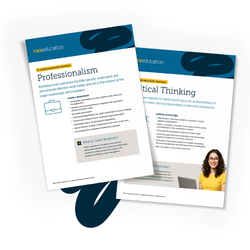
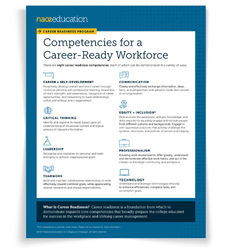
There are eight career readiness competencies, each of which can be demonstrated in a variety of ways. Review a definition of each competency below as well as download supplemental materials to support and incorporate into your initiatives.
Looking for separate files for each competency? Review each one below to download its individual definition and icon set.

Proactively develop oneself and one’s career through continual personal and professional learning, awareness of one’s strengths and weaknesses, navigation of career opportunities, and networking to build relationships within and without one’s organization.
Fee: FREE (member); $750 nonmember. PDF format.
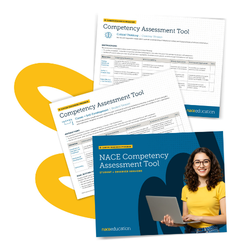
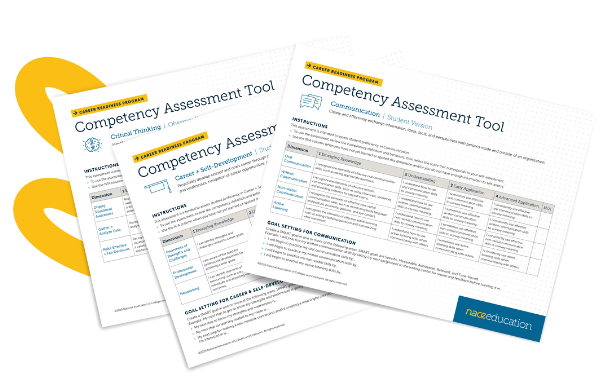
The NACE Career Readiness Competencies play a crucial role in closing the skills gap for the college-educated workforce, but understanding them is just the first step. To translate theory into practice, the NACE Competency Assessment Tool provides a reliable, validated way to measure proficiency in these competencies among students, job candidates, interns, and new hires.
This tool enables a data-driven approach to career readiness by offering actionable feedback and personalized development plans. It supports a shared competency language, facilitates informed decision-making, and contributes to the creation of national benchmarks for equitable candidate preparation and recruitment practices.
Become a member, and get this tool for free today.
Equip faculty and staff with the shared language, confidence, and practical tools to embed career readiness into teaching and student experiences with this hands-on professional development experience.
Participants learn practical ways to integrate competencies into courses, assignments, and co-curricular experiences—supporting academically rigorous learning while expanding access to career-relevant, experiential opportunities that prepare students for the workforce after graduation.


Overall, employers say new college graduates are reasonably well prepared for the jobs they will enter after graduation—and more than 20% say they are very well prepared, according to NACE’s Job Outlook 2026 Spring Update.
Read more
When universities, employers, and students collaborate effectively, college graduates are better equipped to transition confidently into the workforce while strengthening the talent pipeline for the future.
Read more
When reviewing the resumes of Class of 2026 candidates for entry-level positions, employers are seeking graduates who provide evidence of polished teamwork, problem-solving, and communication skills, according to results of NACE’s Job Outlook 2026 Spring Update survey.
Read more
There is a clear and persistent disconnect between how students and employers perceive students’ development of the competencies they need to be career ready as they enter the workforce.
Read moreNACE launched its Career Readiness Initiative in 2015 to address a fundamental need for new college graduates and the professionals who serve their career development needs and recruit them into the workforce: a shared understanding of what is needed to launch and develop a successful career, a common vocabulary by which to discuss needs and expectations, and a basic set of competencies upon which a successful career is launched.
An initial task force—made up of NACE members from both career services and university relations and recruiting—developed the career readiness definition and associated competencies. These were subsequently reviewed and updated by a task force of members in 2017 to reflect feedback from members who were using the competencies with students.
In addition, after the initial launch, NACE undertook work to identify behaviors that could be associated with the competencies, partnering with SkillSurvey to validate those behaviors.
In 2020, a member task force undertook to review and revise the competencies as needed, while NACE and SkillSurvey completed a key phase of its validation effort to identify sample behaviors. As part of its process, the task force drafted its recommendations for revisions and presented them to the NACE membership for comment. More than 300 members provided recommendations and comments. The resulting revised competencies reflect those member insights.
Download the reportIf you wish to reprint the NACE Career Readiness Competencies or definition (for noncommercial use only), please include the following:
Reprinted courtesy of the National Association of Colleges and Employers.

*This competency is currently under review. Recent federal Executive Orders and subsequent guidance, as well as court decisions and regulatory changes, may create legal risks that either preclude or discourage campuses and employers from using it. We will communicate updates about the status of our review as we progress through the process. Before choosing to use this competency, we strongly advise consulting with legal counsel regarding the current state of the law and related legal risks. As reminder, the NACE eight competencies are intended to support career readiness initiatives and are intentionally flexible - they can be utilized in any combination – there is no requirement to use all eight competencies.


 Join/Renew